
How to Remove Facial Hair Permanently
Unwanted facial hair is a common struggle faced by both men and women.
For women, it can affect self-confidence when fine hair appears on the upper lip, chin, or sideburns.
For men, issues like excessive beard growth, ingrown hairs, or the need for constant shaving can be equally frustrating.
These daily struggles frequently make people search for reliable and lasting solutions.
The good news is that facial hair removal is no longer limited to temporary fixes like shaving, waxing, or creams.
With the advancement of dermatology and aesthetics, new techniques such as laser hair removal and electrolysis are now available.
These methods are not only effective but also dermatologically approved, offering safe and long-term results for both men and women.
In this blog, we’ll uncover how to remove facial hair permanently, from natural remedies and at-home solutions to the latest clinical treatments.
You’ll also discover which methods work best for men and women, what results to expect, and how to choose the right option for your needs.
Stay with us, because the insights ahead could save you years of trial-and-error with temporary fixes.

Understanding Facial Hair Growth
Before exploring permanent removal methods, it’s important to understand why facial hair appears and why it can be so persistent.
Causes in Men
For men, hormones like testosterone and dihydrotestosterone (DHT) play the biggest role in facial hair growth.
These stimulate the hair follicles on the face, leading to beard and mustache growth. Genetics also play a big role, in some men naturally grow thicker, denser facial hair, while others struggle with patchy or minimal growth. For men looking to manage unwanted hair in certain areas, laser hair removal for men can be an effective and safe solution.
Causes in Women
In women, facial hair is usually fine and less visible, but sometimes it becomes coarse or darker due to hormonal imbalances.
Conditions like PCOS (Polycystic Ovary Syndrome), menopause, or elevated androgen levels can trigger unwanted hair growth on areas like the upper lip, chin, or jawline.
Genetics and aging can also influence the amount and thickness of facial hair.
Why Permanent Removal Is Challenging
Hair growth occurs in different cycles such as anagen (growth phase), catagen (transition phase), and telogen (resting phase).
Most permanent removal techniques, such as laser or electrolysis, are effective only during the growth phase.
Since not all hairs are in this phase at the same time, multiple sessions are needed to achieve long-lasting results.
Additionally, factors like hormones, genetics, and lifestyle make it difficult to remove facial hair permanently, most of the treatments give long-lasting reduction instead of total removal.
Facial Hair Removal Methods
When it comes to dealing with unwanted facial hair, there are a variety of options available.
Some offer quick and temporary fixes, while others are designed for long-term or even permanent results.
Understanding these options helps you decide which method suits your needs, lifestyle, and budget.
Temporary Facial Hair Removal Methods
These are popular for being quick, affordable, and easy to do at home, but they usually require frequent upkeep:
- Shaving – Fast and painless, but regrowth happens within a few days.
- Waxing – Removes hair from the root and lasts longer than shaving, but can be painful and may irritate sensitive skin.
- Threading – Effective for shaping eyebrows or removing fine hair, but time-consuming for larger areas.
- Depilatory creams – Chemically dissolve hair just below the surface, but results last only a few days and may not suit all skin types.
Long-Term / Permanent Facial Hair Removal Methods
For those looking for lasting solutions, dermatology-approved treatments are the way forward:
- Laser Hair Removal – Uses light energy to target hair follicles, leading to long-term reduction. Works best on dark hair and requires multiple sessions. You can read our detailed guide on laser hair removal treatment cost in India to understand how the procedure works and what results to expect.
- Electrolysis – Destroys each hair follicle with an electric current. It’s the only FDA-approved permanent method, though more time-intensive.
In short, facial hair removal methods range from easy at-home fixes to advanced clinical treatments.
The right choice depends on whether you want a quick solution or a more permanent outcome.
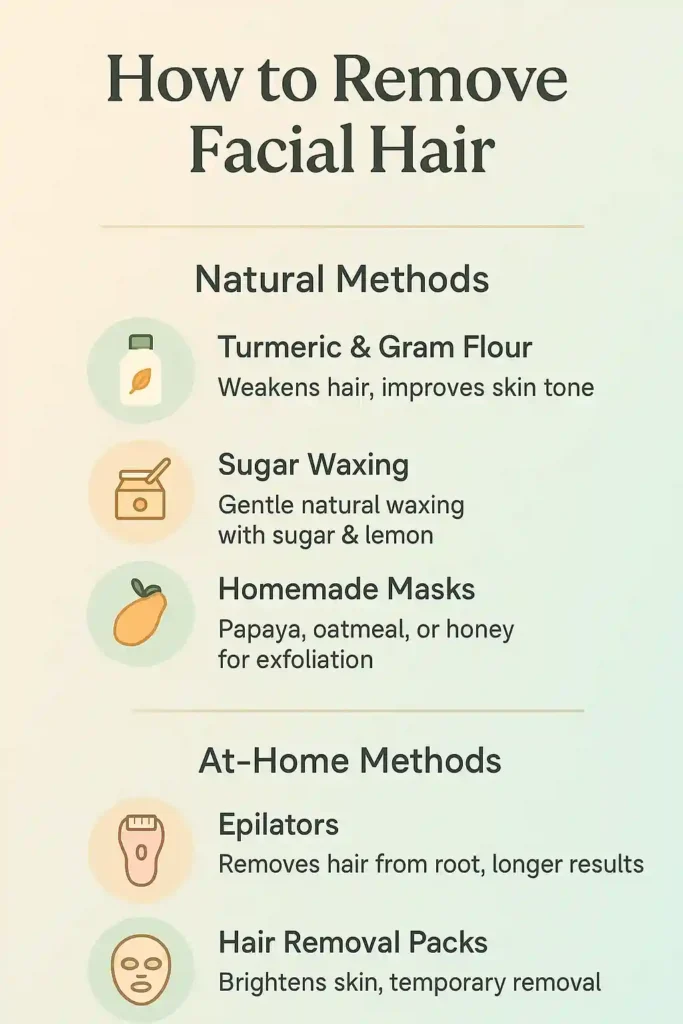
Natural & Home Remedies
For those who prefer gentle and chemical-free options, there are several ways to manage unwanted hair naturally or at home.
While these techniques are popular for being safe, affordable, and convenient, it’s important to note that they usually offer only temporary results or slower regrowth, not permanent removal.
How to Remove Facial Hair Naturally
- Turmeric & Gram Flour Packs – A traditional remedy believed to weaken hair growth over time while also improving skin tone.
- Sugar Waxing (Sugaring) – A natural form of waxing that uses sugar, lemon, and water. It pulls hair from the root and can be less harsh on the skin than regular waxing.
- Homemade Masks (Papaya, Oatmeal, or Honey) – These are often used to soften hair and exfoliate skin, but results vary and usually reduce only fine hair.
How to Remove Facial Hair at Home
- Epilators – Small electronic devices that pull out hair from the root, offering longer results than shaving.
- Hair Removal Packs – Readily available or homemade packs can remove fine facial hair temporarily while brightening the skin.
- Dermaplaning – A popular technique where a small facial razor or blade is used to remove peach fuzz and dead skin, leaving the face smooth.
While these methods can make skin look and feel smoother, their effectiveness is limited. Most of them only slow down hair growth or remove it temporarily, making them better for short-term use rather than permanent solutions.
Hair Removal Creams – Are They Safe?
Hair removal creams, also known as depilatory creams, are a popular choice because they are quick, painless, and easy to use at home.
They work by breaking down the protein structure of hair so it can be wiped away from the skin surface.
But before using them regularly, many people wonder about their safety and long-term effects.
Is Hair Removal Cream Safe?
Generally, hair removal creams are considered safe when used correctly and occasionally. However, they contain strong chemicals that may irritate sensitive skin, especially on the face. It’s always best to do a patch test before applying them to larger areas.
Does Hair Removal Cream Darken Skin?
In most cases, these creams do not darken skin. But if used too often, left on for longer than recommended, or applied on sensitive skin, they may cause irritation, redness, or temporary discoloration. Choosing a cream formulated for the face reduces these risks.
Are Hair Removal Creams Permanent?
While some products may claim to offer unwanted hair removal cream with permanent results, the reality is different.
Hair removal creams only provide temporary results, similar to shaving, as they remove hair just below the surface. Regrowth usually starts within a few days.
Note: Hair removal creams can be a convenient, short-term solution, but they are not a permanent method for facial hair removal.
Laser Hair Removal
Laser hair removal is one of the most effective methods for long-term reduction of facial hair.
It works by targeting the pigment (melanin) in the hair follicles with laser light, which weakens or destroys the follicles over time.
While not 100% permanent, it can reduce hair growth and make regrowth finer and lighter.
Laser Hair Removal for Men vs. Women
Both men and women benefit from laser treatments, but their goals are often different:
| Aspect | Laser Hair Removal for Men | Laser Hair Removal for Women |
|---|---|---|
|
Common Areas |
Beard line, neck, cheeks, ears
|
Upper lip, chin, sideburns, full face |
|
Goals |
Reduce shaving frequency, avoid ingrown hairs, beard shaping |
Achieve smooth, hair-free skin |
|
Benefits |
Reduces fine and coarse hair, smoother complexion |
Laser (for overall facial hair reduction), Electrolysis (for stubborn or white hairs) |
|
Sessions Needed |
6–10 sessions (due to thicker hair) |
6–8 sessions (varies by hair density) |
Male Facial Hair Removal
For men, lasers are especially popular for beard shaping, neck cleanup, and cheek contouring. It helps prevent razor burns, ingrown hairs, and the hassle of daily shaving.
Laser for Men – Growing Demand
Men are increasingly turning to laser treatments because they want low-maintenance grooming and professional results. The demand for male facial laser hair removal has surged in recent years as awareness of its benefits grows.
Face Laser Hair Removal Before and After – What to Expect
- Before: The skin is cleansed, and protective eyewear is given. A cooling gel may be applied.
- During: The laser device delivers light pulses that feel like mild snaps on the skin.
- After: Some redness or swelling may appear but usually subsides within a few hours. Over the following weeks, treated hairs shed gradually, leaving smoother skin.
Limitations of Laser Hair Removal
- Multiple Sessions Needed: Because hair grows in cycles, several sessions are required for best results.
- Cost Factor: It’s more expensive upfront compared to creams or waxing, but often more cost-effective long term.
- Not Fully Permanent: Provides long-term reduction, but occasional maintenance sessions may be needed.
Overall, laser hair removal is the best long-term solution for managing facial hair in both men and women.
Note on White / Grey Hair Removal
Many people wonder about white hair removal and whether white hair laser removal is possible or not.
The truth is, laser treatments work best on dark hair because they target melanin (pigment). Since white and grey hairs lack pigment, the laser cannot effectively remove them.
In such cases, electrolysis is considered the best solution, as it works on all hair colors and offers a truly permanent result.
Electrolysis – Truly Permanent Option
When it comes to achieving true permanent facial hair removal, electrolysis stands out as the most effective method. Unlike lasers, which depend on hair pigment, electrolysis works on all hair types and colors, including stubborn white and grey hairs.
How It Works
Electrolysis uses a fine probe to deliver a small electrical current directly into the hair follicle. This destroys the follicle at the root, preventing it from producing new hair.
Why It’s Effective
- Works on White & Grey Hair – Since it doesn’t rely on pigment, it’s ideal for hair types that laser cannot treat.
- FDA-Approved – Electrolysis is the only method officially approved by the FDA for permanent hair removal.
- Long-Term Results – Once a follicle is destroyed, it cannot grow hair again.
Considerations
- Multiple sessions are usually required since each hair follicle must be treated individually.
- The process can be time-consuming and slightly uncomfortable, but results are permanent.
Best Option for You
Choosing the right method depends on your gender, goals, and whether you want short-term or long-term results.
Here’s a quick comparison:
| Factor | Men | Women |
|---|---|---|
|
Main Goals
|
Beard shaping, neck/cheek cleanup, reduce daily shaving
|
Smooth, hair-free skin on upper lip, chin, sideburns, or full face
|
|
Short-Term Options |
Shaving, waxing, depilatory creams |
Waxing, threading, DIY packs, depilatory creams |
|
Long-Term / Permanent Options |
Laser (for beard shaping & thick hair), Electrolysis (for white/grey hairs) |
Laser (for overall facial hair reduction), Electrolysis (for stubborn or white hairs) |
|
Natural/Home Remedies |
Popular for mild, temporary reduction (turmeric, gram flour, sugar waxing, dermaplaning) |
Limited customization; mostly one-size-fits-all |
|
Best Choice for Permanent Results |
Laser for long-term reduction; Electrolysis for complete, permanent removal |
Laser for long-term smoothness; Electrolysis for complete, permanent removal |
This way, both men and women can quickly see which facial hair removal method suits them best.
What You Should Remember
Facial hair removal comes in many forms, but the right choice depends on your goals and expectations.
Hair removal creams and waxing provide only temporary relief, while natural remedies may slightly slow regrowth but aren’t permanent solutions.
For those who want long-lasting results, laser hair removal is the best option for significant reduction, and for complete, permanent removal, including white or grey hairs – electrolysis remains the gold standard. See real results with Tanya’s laser hair removal journey
FAQs
At-home remedies like turmeric, gram flour, or sugar waxing can slow hair growth but don’t provide permanent results. For long-term solutions, clinical options like laser or electrolysis are more effective.
Electrolysis is the only FDA-approved method for permanent facial hair removal, working on all hair types, including white and grey. Laser hair removal offers long-term reduction but isn’t fully permanent.
You can slow facial hair growth with home remedies, hair removal creams, or waxing, but for lasting results, laser or electrolysis are the best options. Hormonal balance also plays a role, especially in women.
Female facial hair can be caused by genetics, hormonal changes, or conditions like PCOS. Aging and menopause may also make hair appear coarser or more visible.
Yes, facial hair removal is generally safe when done correctly. Methods like waxing, threading, and depilatory creams are temporary, while dermatology-approved treatments like laser and electrolysis are safe for long-term use.
Many women opt for facial hair removal methods, ranging from natural remedies to lasers, for smoother skin and confidence. Permanent options like electrolysis can be considered if hair growth is a concern.
Our clinics are located in following cities only, to visit our nearest clinic, contact us |
|
| Pune | Baner |
| Karve Road | |
| Koregaon Park | |
| Hyderabad | Kukatpally |
| Banjara Hills | |
| Jaipur | Bapu Nagar |
| Goa | Porvorim |
| Mumbai | Andheri West |