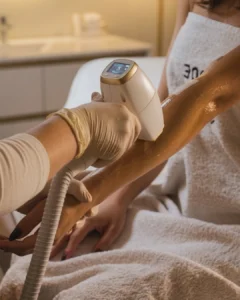
Why Deep Acne Scars Need Specialized Treatment
Did you know that 80% of people with acne develop some form of scarring? Deep acne scars are not surface-level marks. They extend into deeper skin layers, affecting the dermis and tissue beneath. Unlike dark spots that fade over time, deep scars involve actual tissue loss. Understanding how acne scars differ from marks is crucial for selecting the right treatment approach. This is why regular face creams don’t work on them.
When severe acne causes inflammation, it damages deeper skin layers. Your body either produces too little collagen (causing depressed scars) or too much (causing raised scars). The greater the inflammation, the higher the scarring risk. Factors include genetics, treatment timing, picking behavior, and acne severity. Indian skin tones are more prone to post-inflammatory hyperpigmentation.
Our Nearest Skin and Hair Clinic in India
Choose Your City
Choose Your Location
Our Clinic Near You
is Located in Andheri West
is Located in Porvorim
is Located in Bapu Nagar
is Located in Kukatpally
is Located in Banjara Hills
is Located in Baner
is Located in Karve Road
is Located in Koregaon Park
Deep acne scars are stubborn but treatable. This guide covers proven options – from home remedies to advanced procedures. You’ll learn which treatments suit your scar type and realistic results to expect.
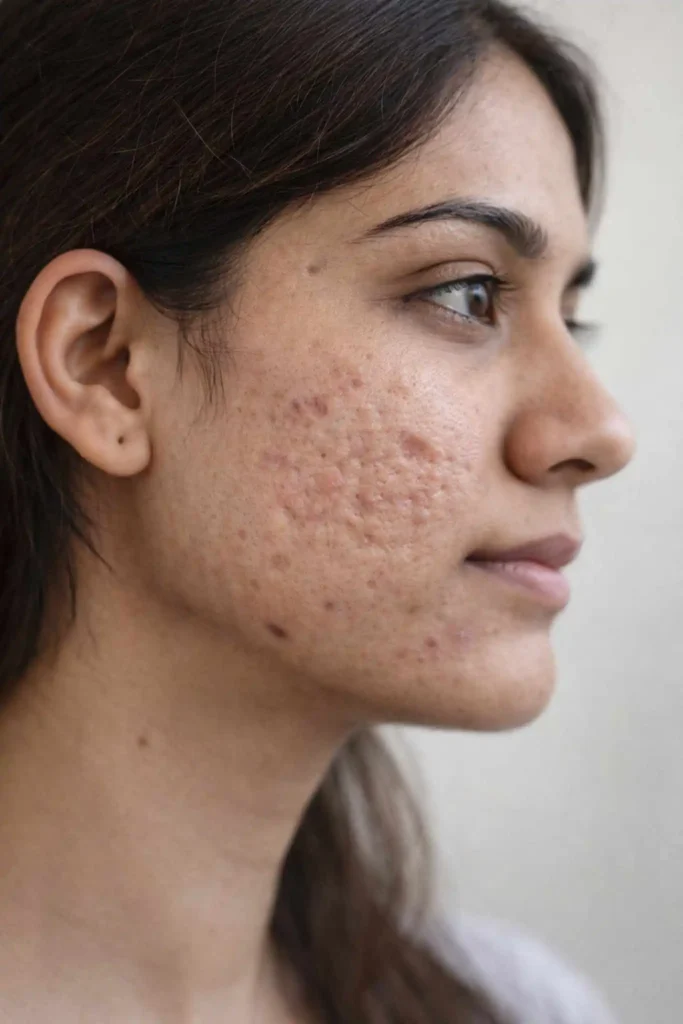
Understanding Deep Acne Scars
Not all acne scars are the same. Knowing your scar type helps you choose the right treatment.
Types of Deep Acne Scars
- Ice-Pick Scars: These are narrow, deep scars that look like small puncture holes in your skin. They extend vertically deep into the dermis or subcutaneous tissue. Ice-pick scars are the most difficult to treat because of their depth.
- Boxcar Scars: These scars have broad, box-like depressions with sharp, defined edges. They’re wider than ice-pick scars but not as deep. Boxcar scars respond well to resurfacing treatments.
- Rolling Scars: Rolling scars have sloping edges and create a wave-like, uneven texture on your skin. They form when fibrous bands pull the skin downward. These scars vary in depth and size.
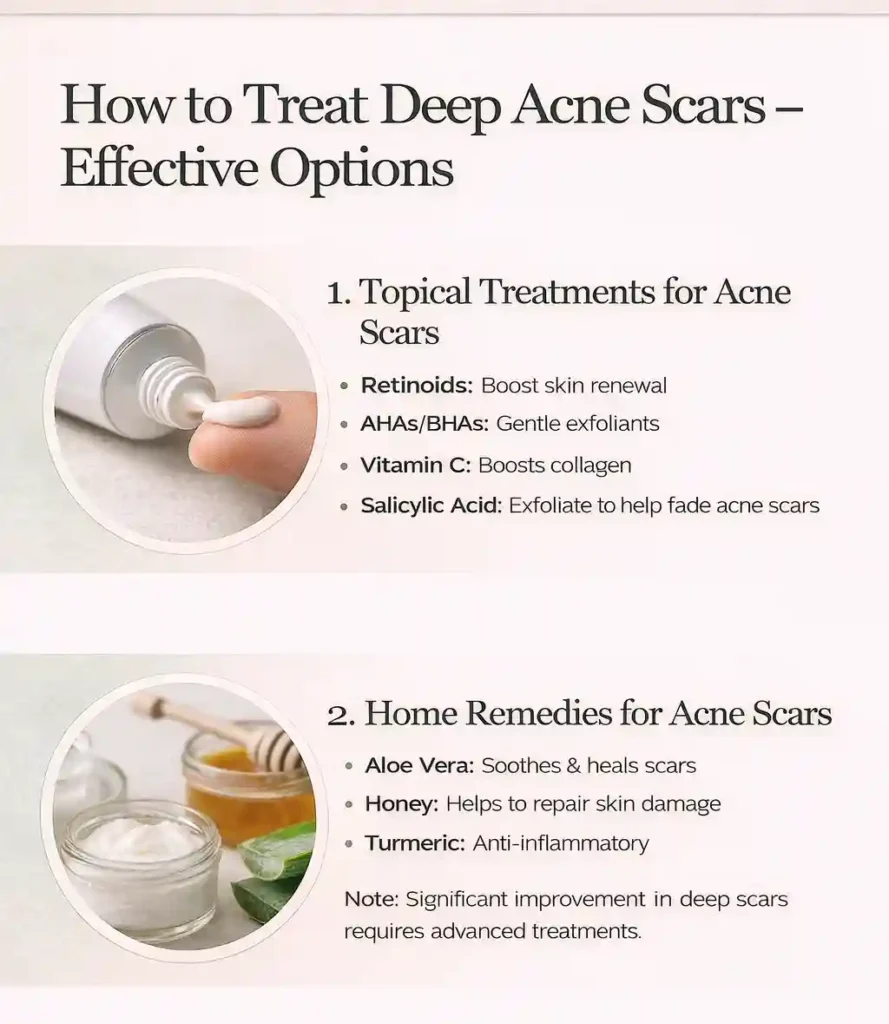
How to Treat Deep Acne Scars - Effective Options
1. Topical Treatments for Acne Scars
While topical treatments have limitations for deep scars, they can help with mild scarring and pigmentation.
Retinoids
Products containing retinoids (like Adapalene) are derived from Vitamin A. They work by:
- Increasing skin cell turnover
- Fading acne scars faster
- Preventing new breakouts
Use retinoids at night on clean skin. Start with a small amount as they can cause initial dryness.
AHAs/BHAs
Alpha Hydroxy Acids (like Glycolic Acid) gently remove dead skin cells and fade dark spots. Beta Hydroxy Acids (like Salicylic Acid) go deep into pores to clear oil and reduce inflammation.
Vitamin C
This powerful ingredient stimulates collagen production and reduces discoloration. Learn more about salicylic acid benefits and proper usage guidelines for optimal results.
Salicylic Acid
Salicylic acid exfoliates the skin and helps lighten shallow scars. It’s particularly effective for post-acne marks and mild surface scarring.
2. Home Remedies for Acne Scars
Home remedies can support healing for mild scars but have serious limitations for deep scarring. For expert insights on natural scar remedies, including what works and what doesn’t, consult evidence-based approaches.
- Aloe Vera: Fresh aloe vera gel has soothing and healing properties. Apply it directly to scars twice daily for 20-30 minutes. It helps reduce inflammation and lighten marks.
- Honey: Raw honey keeps skin hydrated and supports healing. Apply a small amount to scars, leave for 15-20 minutes, then rinse. It has natural antibacterial properties.
- Lemon/Turmeric: While these ingredients are popular in Indian households, they can cause skin irritation. Lemon is acidic and may worsen pigmentation if used incorrectly. Always dilute and patch-test first.
Home remedies cannot repair deep pitted scars like ice-pick or boxcar scars. They may slightly improve pigmentation and texture, but professional dermatological treatments are necessary for significant improvement of deep scarring.
Advanced Dermatological Treatments for Deep Acne Scars
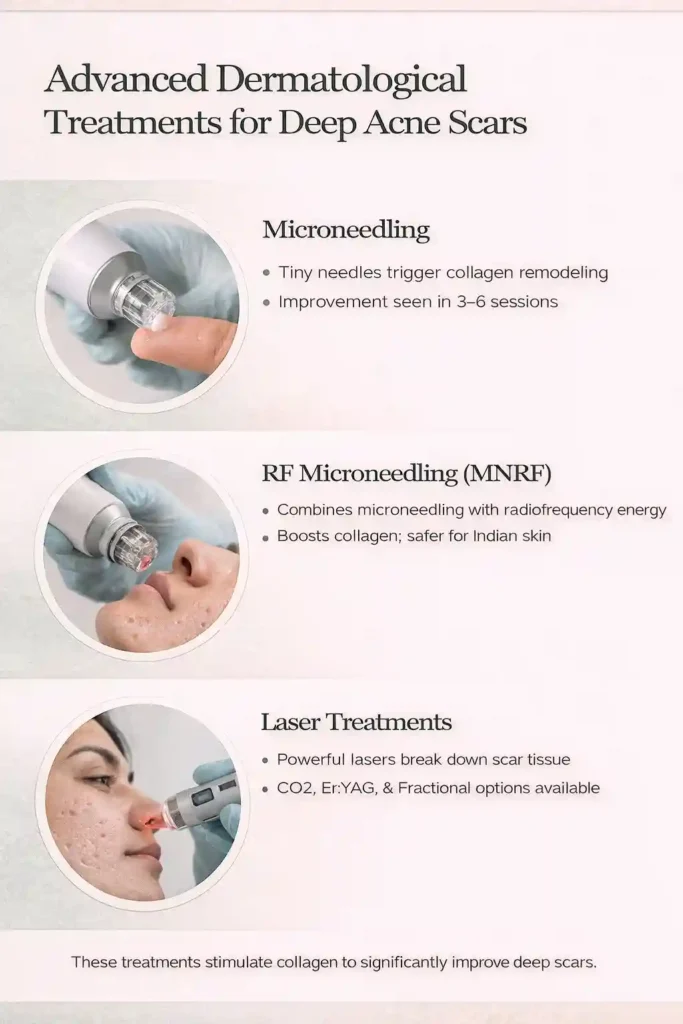
1. Microneedling for Acne Scars
Microneedling, also called collagen induction therapy, uses tiny needles to create controlled micro-injuries in your skin.
How It Works
- Needles puncture the skin at various depths (1.5mm to 3.5mm)
- This triggers your body’s natural healing response
- Stimulates collagen and elastin production
- New skin gradually replaces scarred tissue
Best Suited Scar Types: Microneedling works well for rolling scars, shallow boxcar scars, and overall skin texture improvement. Studies show it’s less effective for ice-pick scars due to their depth.
Expected Results: Medical research indicates that patients typically need 3-6 sessions for noticeable improvement. In Indian studies, approximately 58% of patients showed moderate improvement, while 29% showed minimal improvement. Results appear gradually over 4-6 weeks as collagen remodels.
2. Microneedling Radiofrequency (MNRF)
This advanced version combines microneedling with radiofrequency energy. The heat generated stimulates deeper collagen production. Indian studies show that 80% of patients with severe scars improved by 2 grades after microneedling RF treatment. MNRF is considered safer for darker Indian skin tones.
3. Laser Treatment for Deep Acne Scars
Laser treatments are highly effective for deep scars.
Types of Lasers
- CO2 Laser: Most powerful for CO2 laser treatment deep scarring with 25-90% efficacy. Downtime: 5-7 days.
- Er:YAG Laser: Gentler option, suitable for sensitive skin. Downtime: 3-5 days.
- Fractional Lasers: Target skin in fractions, faster healing, ideal for mixed scar types.
How Laser Works: Lasers apply controlled heat to deeper skin layers, removing damaged tissue and triggering collagen production. Research shows lasers deliver superior results for ice-pick and boxcar scars compared to microneedling alone.
Combination Treatments for Faster Improvement
Why Deep Scars Need Multiple Approaches
Deep acne scars are complex. A single treatment addresses only one problem, but combination therapies tackle multiple factors:
- Subcision releases fibrous bands pulling skin downward
- Lasers and microneedling stimulate new collagen formation
- PRP (Platelet-Rich Plasma) accelerates healing with growth factors
- Fillers provide instant lift for residual depressions
Common Effective Combinations
- Microneedling & PRP: Studies show 62% improvement with this combination versus 45% with microneedling alone. PRP contains growth factors that enhance collagen remodeling.
- Laser & Subcision: This powerful combination works especially well for rolling and boxcar scars. Subcision releases the scar base while laser resurfaces the skin.
- TCA CROSS & Microneedling RF: TCA CROSS targets individual ice-pick scars while MNRF improves overall texture. This customized approach addresses different scar types simultaneously.

Acne Scar Treatment Side Effects
All treatments carry some temporary side effects:
Common Side Effects
- Redness lasting 1-7 days
- Mild swelling for 24-48 hours
- Temporary skin sensitivity
- Mild discomfort during procedure
Specific to Lasers
- Post-inflammatory hyperpigmentation (especially in darker skin)
- Longer redness (up to 3 months with ablative lasers)
- Risk of temporary hypopigmentation
Specific to Microneedling
- Bleeding and bruising
- Temporary skin tightness
- Peeling after 2-3 days
Downtime Variance Between Treatments
- Microneedling RF: 2-3 days
- Fractional Erbium Laser: 3-5 days
- Fractional CO2 Laser: 5-7 days
- Subcision: 3-5 days with possible bruising
Indian skin is prone to pigmentation issues, so proper pre and post-care with sunscreen and brightening serums is essential.
How to Choose the Right Treatment for Your Scar Type
Treatment Selection Guide
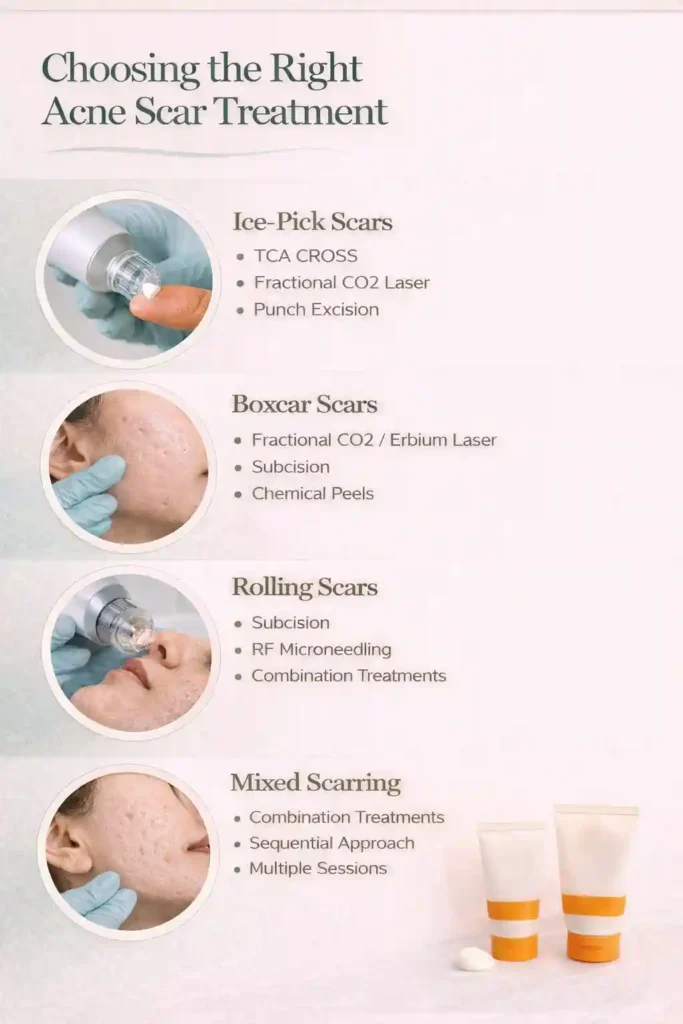
For Ice-Pick Scars:
- TCA CROSS technique
- Fractional CO2 laser
- Punch excision techniques
Note: These respond poorly to microneedling alone
For Boxcar Scars:
- Fractional CO2 or Erbium lasers
- Subcision for deeper variants
- Chemical peels for shallow boxcar scars, especially when combined with other modalities
For Rolling Scars:
- Subcision
- Microneedling or MNRF
- Combination with fillers
For Mixed Scarring:
- Customized combination treatments
- Sequential approach addressing each type
- Multiple modalities over several sessions
When to Consult a Dermatologist
Consult a dermatologist immediately if:
- Your scars have been present for over a year
- Home remedies show no improvement after 3 months
- You have deep pitted or raised scars
- You’re noticing worsening pigmentation
- You want professional assessment of your scar type
A qualified dermatologist will examine your skin, determine your scar types, and create a personalized plan using proven acne scar treatments based on your skin type, budget, and expectations.
Can Deep Acne Scars Be Completely Removed?
Complete removal is challenging, but significant improvement is possible. Studies show 60-85% of patients achieve moderate to good results with proper treatment. Combination approaches work better than single treatments, and recent scars respond better than old ones.
No treatment guarantees complete removal. However, modern procedures can make scars 60-90% less noticeable. The goal is smooth texture and even tone.
Success requires:
- Treating active acne early to prevent scarring
- Never picking or squeezing pimples (increases scarring by 40-50%)
- Following treatment plans consistently (4-6 sessions needed)
- Daily sunscreen and proper skincare
- Patience – results take 3-6 months
Deep acne scars are challenging but treatable. With professional treatments, proper care, and realistic expectations, you can achieve significantly clearer skin. Consult a certified dermatologist to begin your journey today.
FAQs
Hormonal acne during pregnancy is best managed with safe, pregnancy-approved treatments like topical azelaic acid, gentle cleansers, and non-comedogenic skincare. For comprehensive information on pregnancy skin concerns, including safe treatment options, refer to expert guidance.
Deep acne scars don’t usually fade on their own, but they can significantly improve with treatments like microneedling, lasers, subcision, or chemical peels. Multiple sessions are often required for visible results.
Most acne scars can be improved by 50–90%, but complete removal is rarely possible. The right combination of treatments can make scars appear much smoother and far less noticeable.
Deep acne scars form when severe inflammation damages collagen in the skin, creating depressions as the tissue heals. Picking or popping pimples can worsen the depth and severity of scarring.
Deep acne scars respond best to advanced treatments like laser resurfacing, microneedling, subcision, TCA CROSS, and PRP therapy. A dermatologist can recommend a customized combination plan based on your scar type.
Deep scars can take several months to years to improve depending on skin type and treatment choice. With professional treatments, visible improvement is usually seen within 3–6 months.
Ice-pick scars are considered the most difficult to treat because they are narrow and deep. They usually require targeted procedures like TCA CROSS or combination treatments for best results.